

The biggest change in search isn’t AI.
It’s that search no longer ends.
In the last issue, I wrote that SEO, AEO, and GEO are not separate disciplines but different expressions of the same system. That system still exists, but what Google shared at I/O, and more importantly, in the documentation that followed, adds another layer to it.
Over the past few days, I’ve been going through Google’s AI Mode insights in detail. Not just the announcements, but the underlying usage patterns. All data and signals in this issue come directly from Google's post-I/O publications. These are not estimates or projections. They are Google’s own reported numbers.
The shift here isn’t really about features. It’s about behavior.
What used to be a relatively simple interaction, a query, a set of results, a click, is quietly turning into something far more continuous.
People are no longer searching once and moving on. They are asking, refining, comparing, and deciding, often within the same interaction, without ever really ending the search.
One detail from Google’s AI Mode Insights report stood out immediately: follow-up queries in AI Mode have increased by more than 40% on average per month in the U.S.
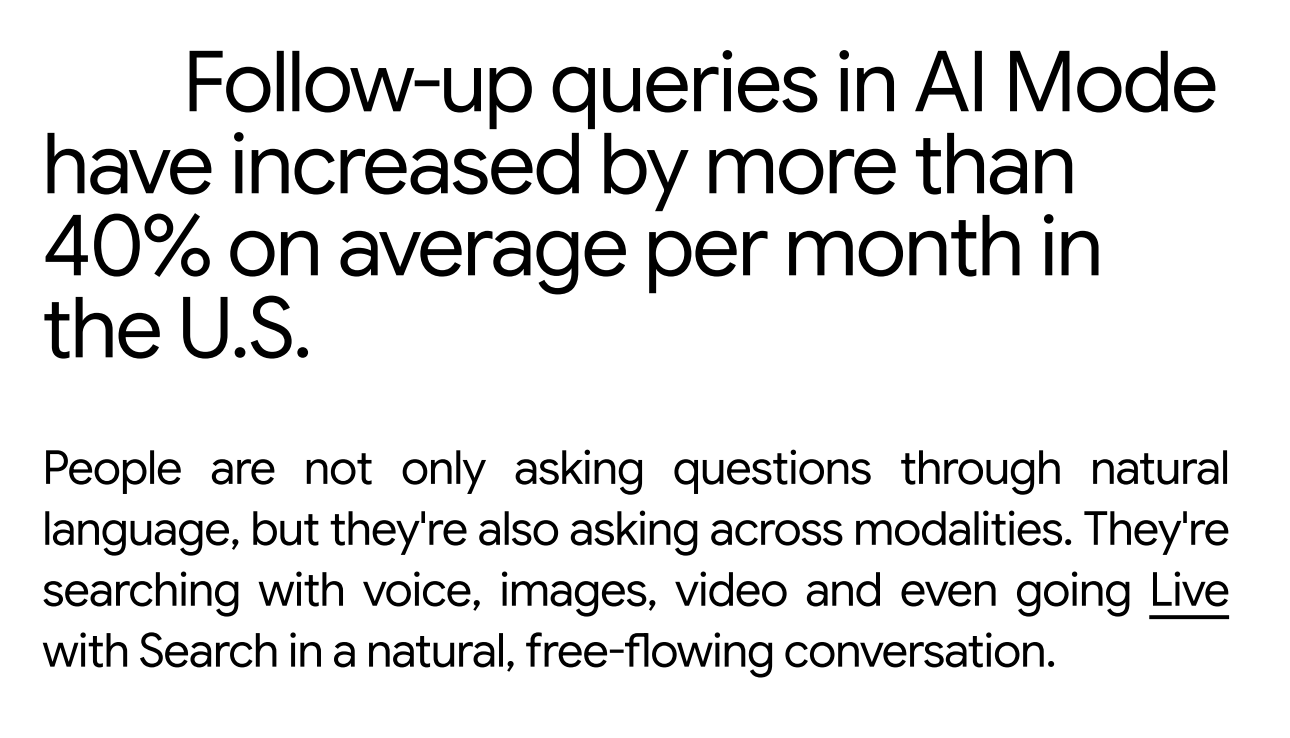
That doesn’t just signal higher engagement. It suggests a different relationship with search itself. Users are treating search as something iterative, a space where they think through a problem rather than just look something up.
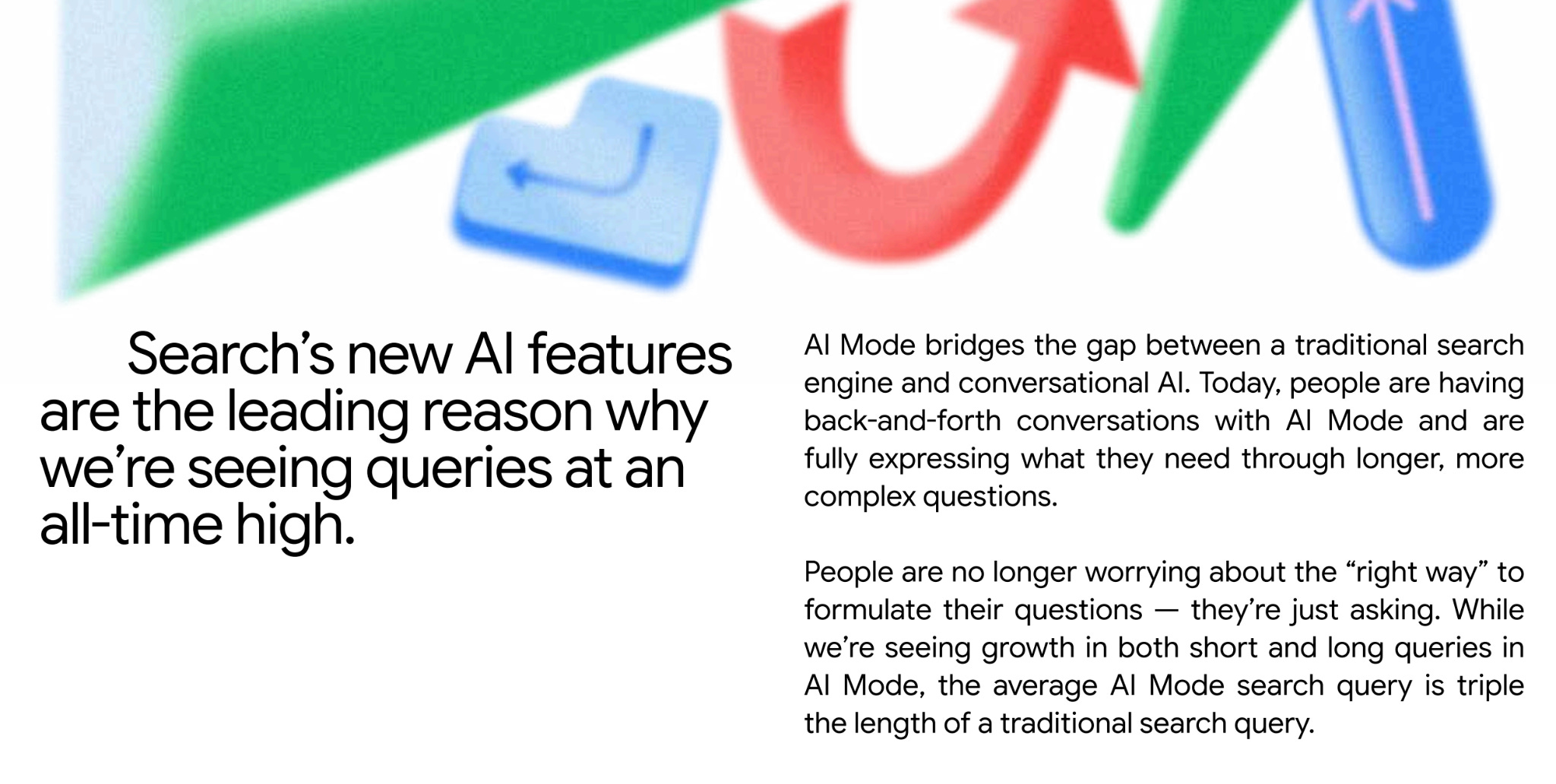
The average AI Mode query is 3x longer than a traditional search query. Search is no longer a lookup mechanism. It is becoming part of the decision-making process itself.
What kind of process, exactly?
In the traditional model, a user translated their need into a query, evaluated results, and repeated that process manually. Each step was disconnected. Every refinement required a new search, a new scan, a new decision.
What AI Mode does is collapse that loop into a single environment. The user no longer needs to restart with every refinement. They can stay inside it, adjust their question, clarify constraints, and move toward a decision without breaking context.
That changes how intent develops. Instead of being clearly defined at the beginning, intent becomes clearer as the interaction progresses.
Users often start with something vague, refine it through follow-ups, and only arrive at a concrete need several steps later.
For marketers, this introduces a different challenge. You are no longer trying to match a fixed query. You are trying to stay relevant as the user’s thinking evolves.
Why This Matters More Than the Visible Changes
Most of the discussion coming out of Google I/O has focused on visible changes: longer queries, multimodal inputs, conversational interfaces.
All of that is real. But it is not the most important part.
The more meaningful shift occurs after the first query. Users are staying in the system longer, refining their meaning in real time, and comparing options without opening multiple tabs.
They are moving from question to decision in a single continuous interaction.
Traditional SEO focused largely on discovery. The challenge now is to stay relevant throughout the interaction, not just appear at the start.
A More Useful Way to Think About the Journey
If search is now continuous, it helps to think about where your content fits within that continuity.
Most journeys today move through three broad phases.
The entry point
The initial question that brings a user into the system. This is where traditional SEO has always focused, and it still matters. If you are not visible here, nothing else happens.
Expansion
Where users refine what they are looking for, ask follow-up questions, and explore alternatives. This is also where intent becomes clearer.
Decision
Where a user moves from understanding to choosing. Increasingly, that decision is being shaped inside AI-generated responses rather than across multiple websites.
Most teams are still optimizing almost entirely for the first phase. But the leverage is shifting toward the second and third.
I see this pattern regularly when reviewing content strategies for B2B brands. A company ranks well for the category-level query, the entry point, but their content stops there. There is nothing to support the buyer who then asks a follow-up.
How does this compare to the alternative? What does implementation look like? What have other companies in my industry done? Those follow-up questions are where the decision actually forms.
In most cases, a competitor with weaker rankings but deeper content coverage ends up shaping the outcome. The first query brought the buyer in. Someone else closed them.
What the Data Actually Shows
The length of AI Mode queries is easy to interpret as a shift toward natural language. The more important point is what users are doing with that extra space.
They are expressing complete situations, with constraints, preferences, and outcomes, in a single interaction.
This changes how we think about keywords. Instead of isolated phrases, you are dealing with scenarios. If your content does not map to those scenarios, it becomes much harder to stay relevant beyond the initial interaction.
Decision-oriented queries tell a sharper story. Queries starting with “which” are growing 40% faster than overall AI Mode queries. Users are moving closer to decisions within the search experience itself, rather than treating search as a separate research step.
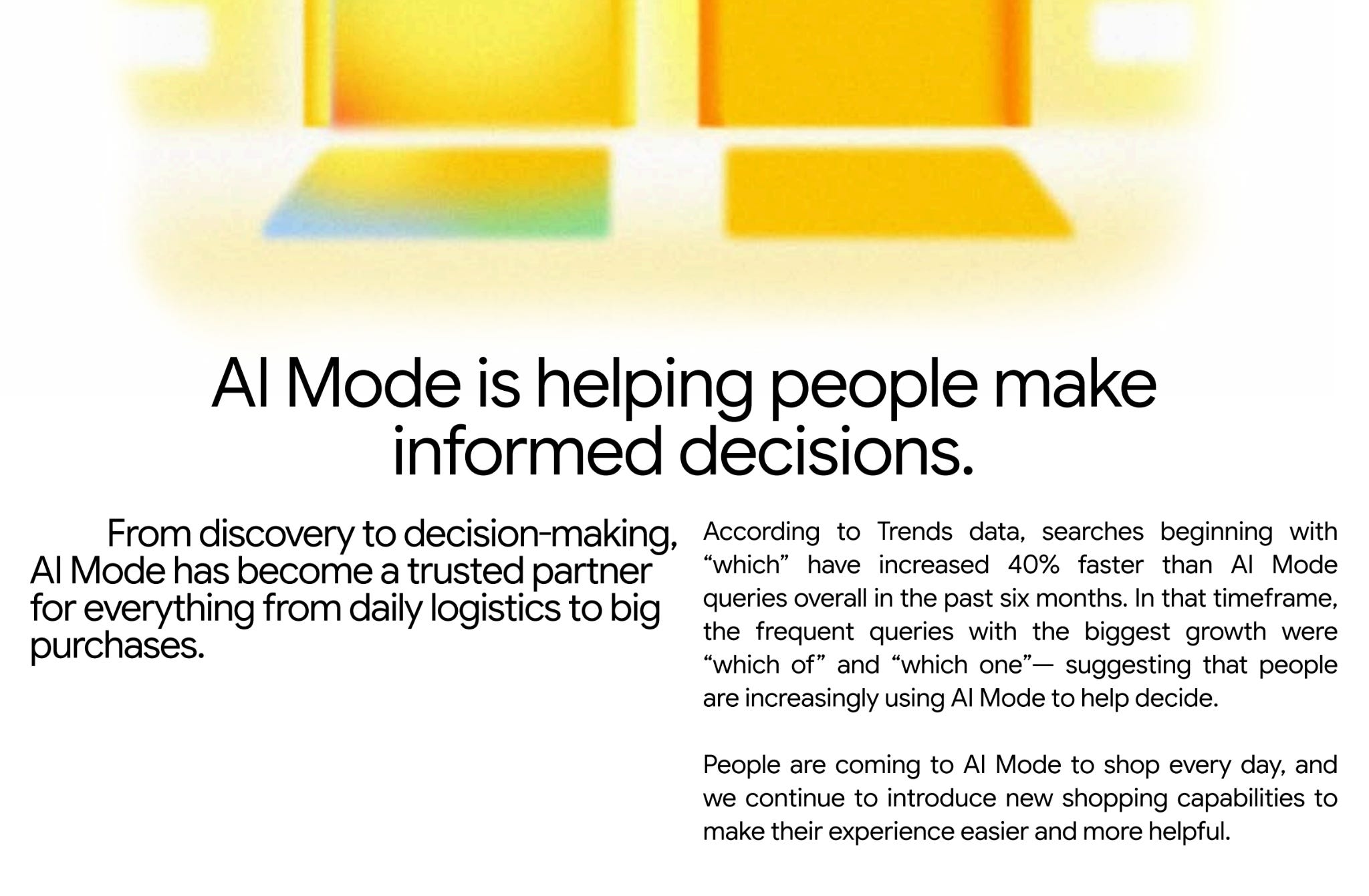
From a content perspective, this raises the bar. Informational content alone is not enough. You need content that helps users evaluate options, understand trade-offs, and build confidence in a decision.
Counterintuitively, search volume itself is increasing. AI Mode queries have more than doubled each quarter since launch, and AI Mode has surpassed 1 billion monthly active users globally.
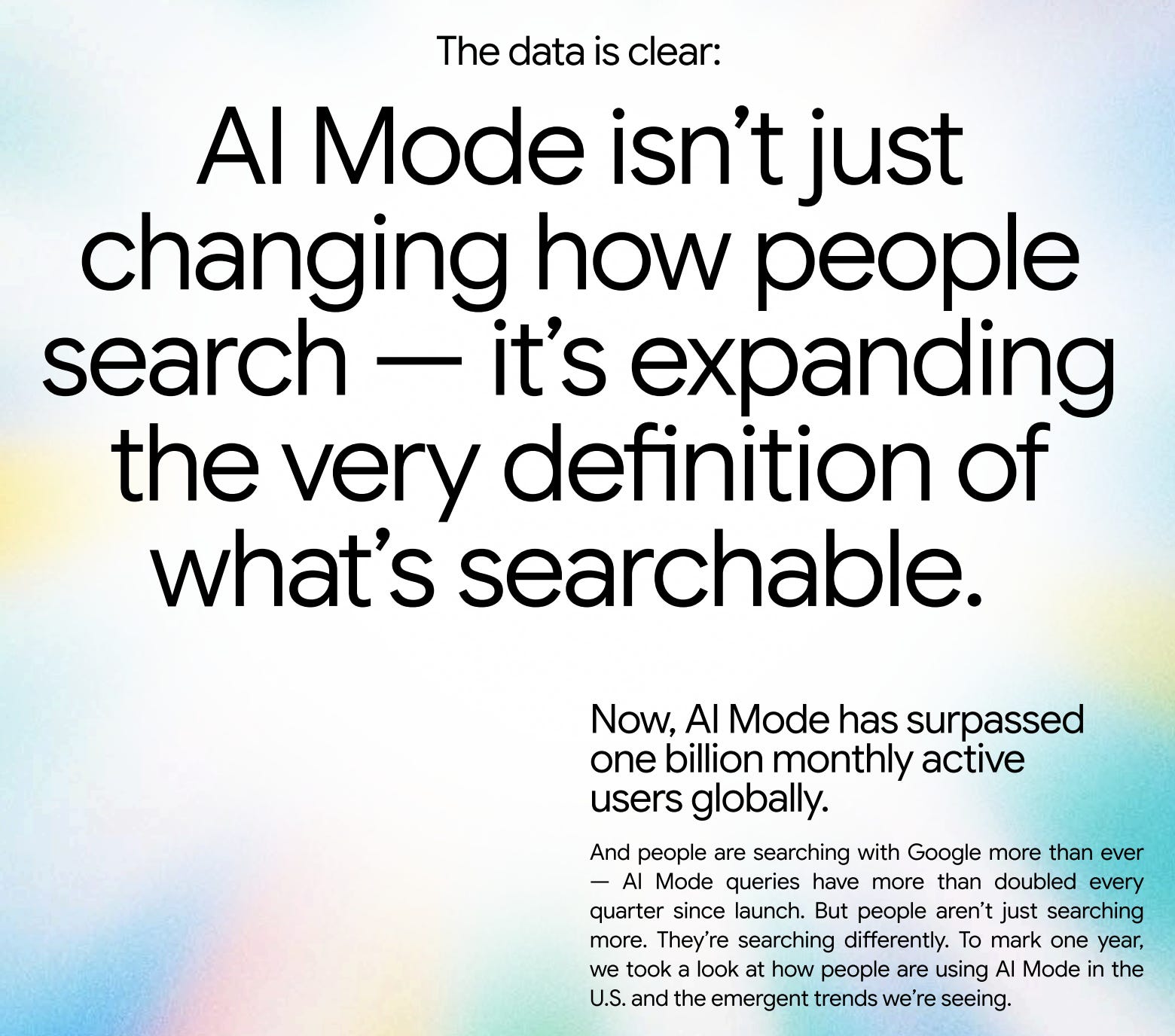
There is a common assumption that AI answers will reduce the need to search. The data says the opposite. When friction drops, people explore more, ask more questions, and iterate on their thinking.
Search becomes less about finding an answer and more about working through a problem. That expands the total surface area of opportunity, but it also increases competition within that process.
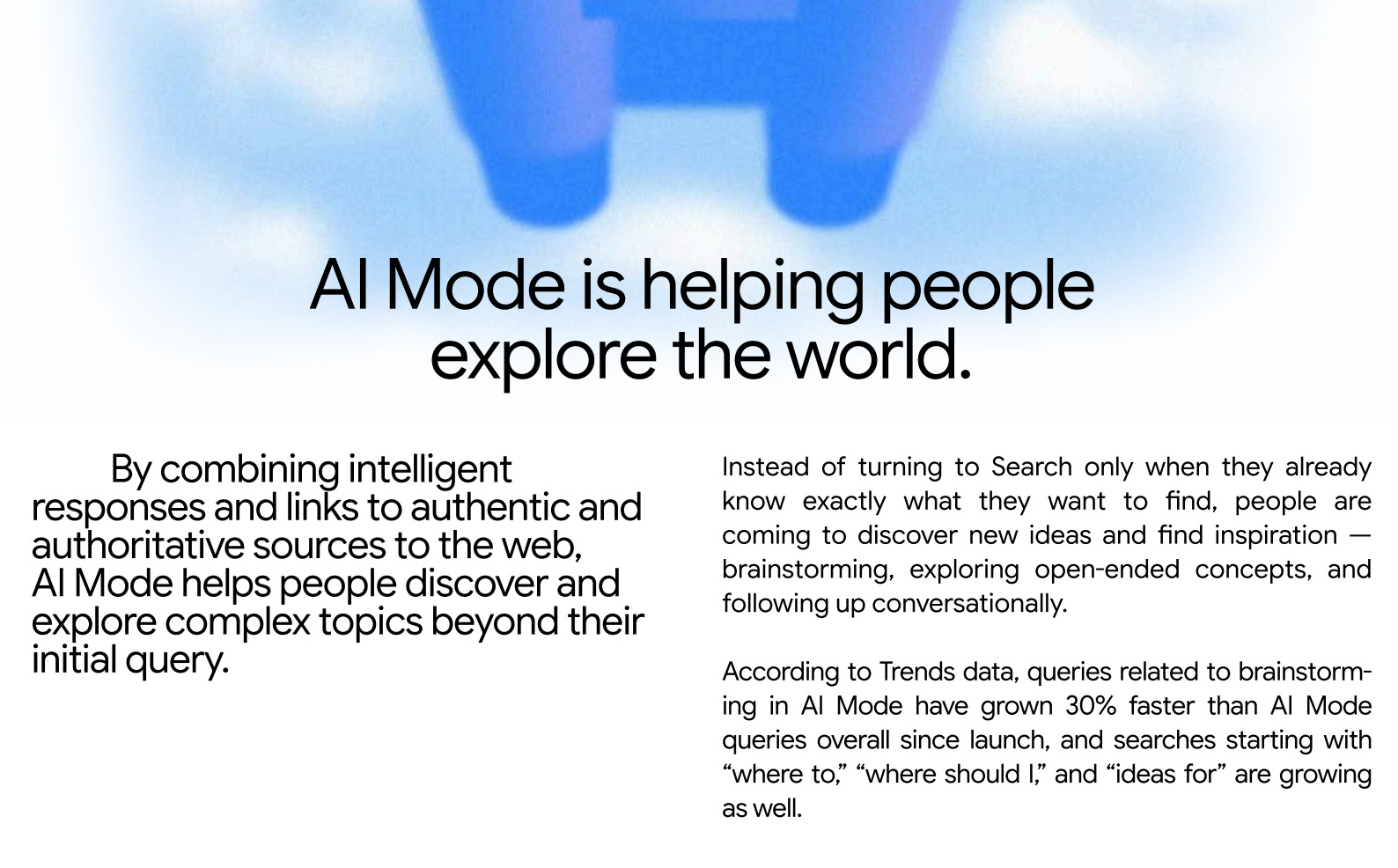
Open-ended queries reflect a related shift. Brainstorming-related queries are growing 30% faster than overall AI Mode queries. People are not always searching with a clear goal in mind. They are asking for ideas, exploring options, and using search to figure out what they want in the first place.
This matters because traditional SEO assumes intent exists before the query. In many cases now, intent is being formed during the interaction.
That makes early-stage visibility more important, but also harder to earn. You are not just answering questions. You are helping shape the direction of the search itself.
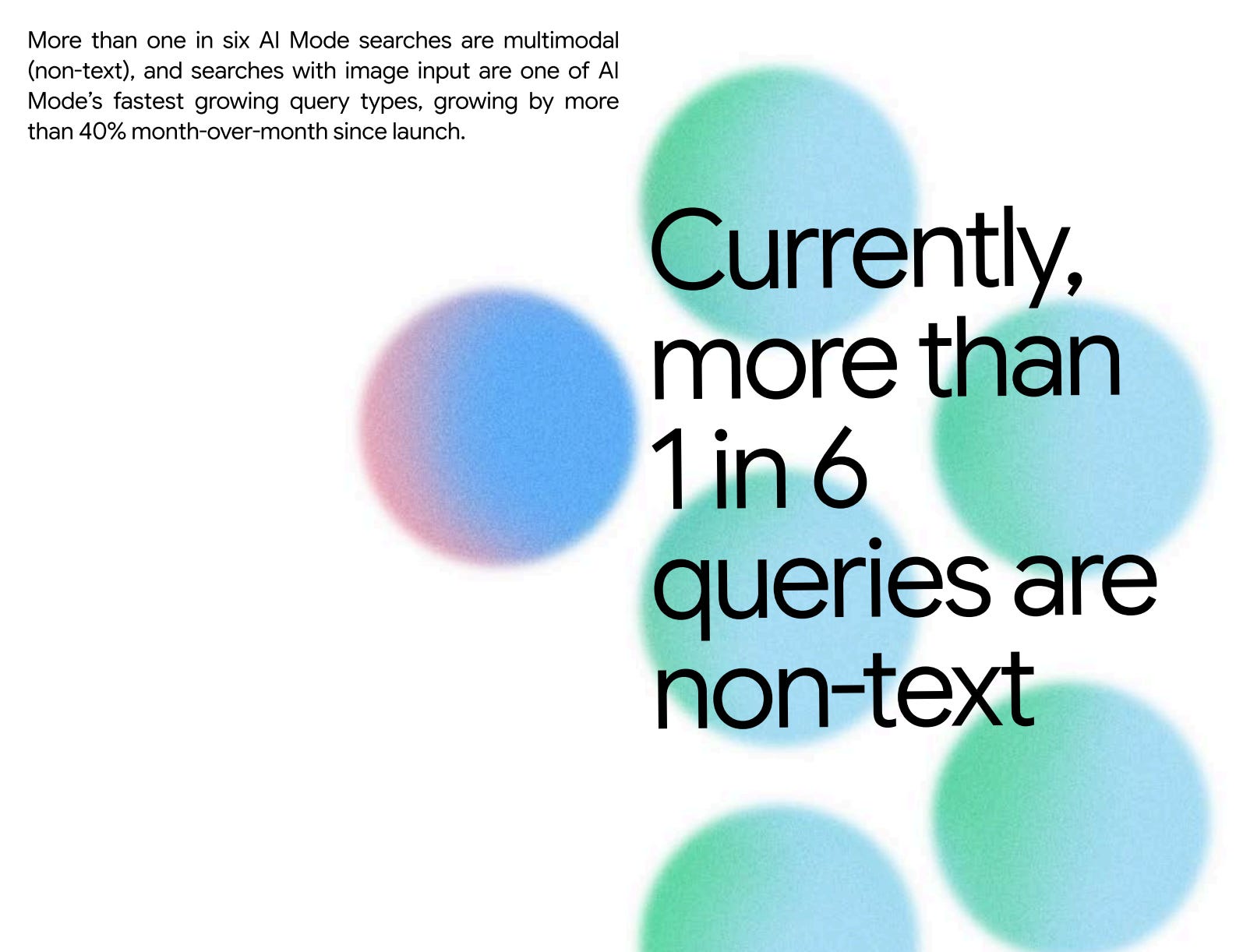
Multimodal search is accelerating alongside all of this. More than 1 in 6 AI Mode queries are now non-text. Image-based queries are growing more than 40% month-over-month. If your strategy is built entirely around text, you are covering only part of the surface area.
But the most important shift, in my view, is how Google is framing the purpose of search itself. The way they describe AI Mode usage across exploring, deciding, learning, doing, and creating is not about information retrieval. It is about task completion.
People are planning trips, comparing products, creating content, and organizing decisions inside the same system. Planning-related queries are growing at 80% the rate of overall AI Mode queries.
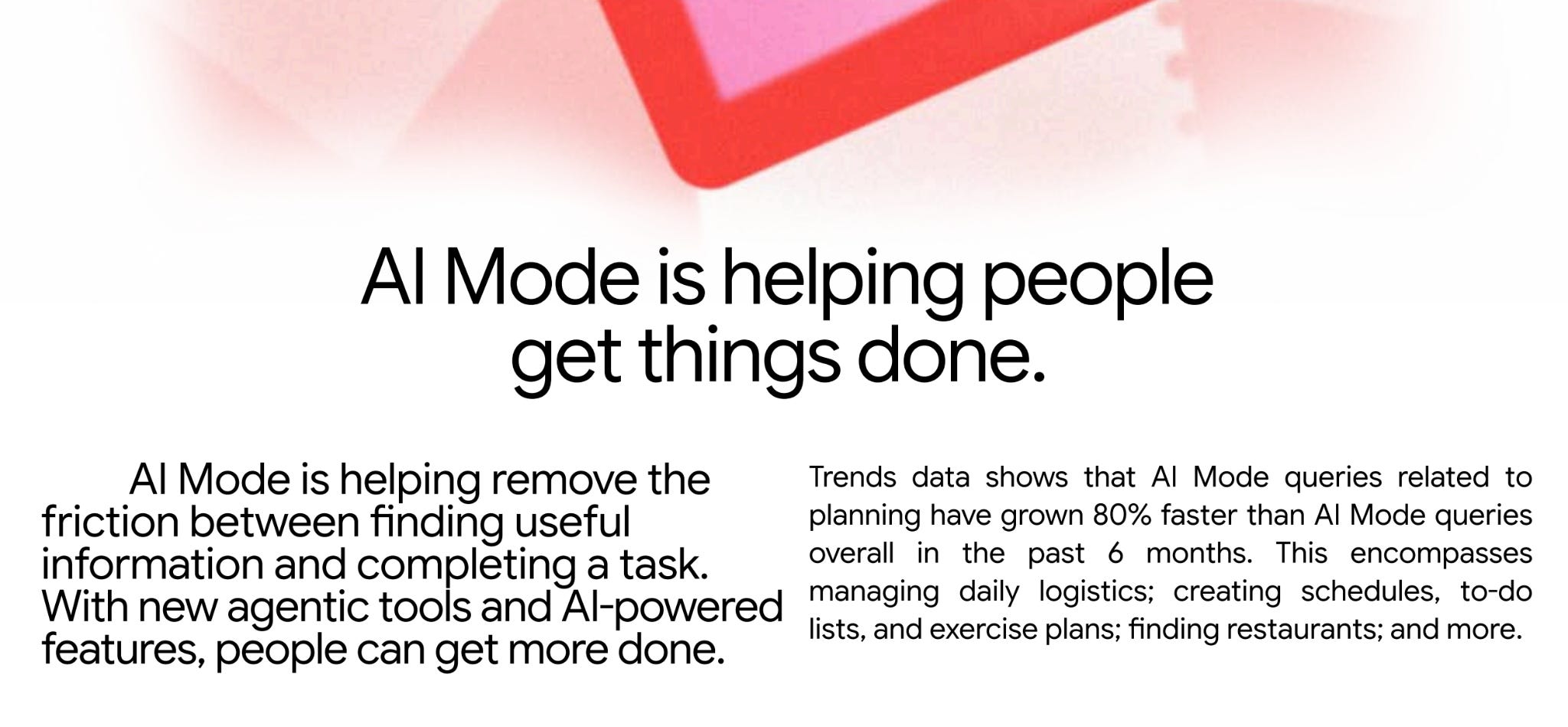
Search is becoming a layer for getting things done.
What This Breaks
Keyword-first thinking becomes less reliable
If intent is not fully formed at the beginning, optimizing for a fixed query only solves part of the problem.
Page-level optimization faces a similar constraint
A single-page answer to a single question is less useful in a world where users move through multiple layers of understanding within a single interaction.
Traffic becomes a weaker proxy for impact
Your content may influence a decision without generating a click. It may shape the outcome of an interaction that never leaves the AI interface. Current attribution tools make that hard to measure. That does not make it less real.
What This Demands Instead
Think in terms of coverage, not entry points
Are you present at each stage of the journey? Can you support not just the initial question, but the refinements and comparisons that follow?
Clarity becomes a structural advantage
When decisions are being shaped inside generated responses, content that is easy to extract, interpret, and trust performs better. This is not a new idea. The difference is that the stakes are now much higher.
Proof matters more than it did
As decision-making moves closer to the interface, the signals that support credibility, experience, specificity, and consistency become more important. Not as abstract qualities, but as things that are visible in the content itself.
In practice, what I find missing most often is the third layer: proof. Most B2B brands have informational content. Some have comparison content. Very few have content that demonstrates credibility through specific, verifiable experience.
Not case studies written for sales decks, but real observations from doing the work. When AI systems decide which source to cite in a generated response, that specificity is one of the signals that tip the balance.
Generic authority does not hold the same weight it once did.
Where This Leaves Us
In the last issue, I framed SEO, AEO, and GEO as part of the same system.
This builds on that. That system is no longer centered around isolated searches. It is increasingly centered around continuous interactions.
Search is no longer about being found once. It is about remaining relevant throughout an evolving interaction, as the user refines what they need, compares options, and moves toward a decision.
That is a higher bar than ranking for a query. It requires a shift in how we think about content.
Not as isolated answers, but as support for an evolving decision-making process.
If I Had to Reduce This to One Idea
Most content strategies are still built around the first question.
But the search no longer ends there.
The brands that win will be the ones that show up not just at the beginning, but throughout the process, as the user’s thinking becomes clearer and the decision takes shape.
Source: Google AI Mode Insights Report, May 2026. storage.googleapis.com/gweb-uniblog-publish-prod/documents/AI-Mode-US-Insights.pdf
Until next time,
Pratik Dholakiya
AI Search Visibility Practitioner
Founder, Growfusely | SearchExperience.AI