

Most AEO advice repeats itself. Open three playbooks, and you get the same list of tactics in a slightly different order.
A playbook Scale Venture Partners put out a couple of months ago was an exception. It came out of a session with Sydney Sloan, who advises CMOs and spent years at G2, and a few of its ideas are worth more than the rest of the genre put together.
It was written by investors for the companies they back, so it tells you what to do without spending much time on why it works or where it breaks. That gap is what I want to fill here.
Below is the one number in it worth a budget conversation, the one idea worth the whole document, and the two places I read it differently.
Start With the Number That Pays for Everything
The playbook opens with four stats.
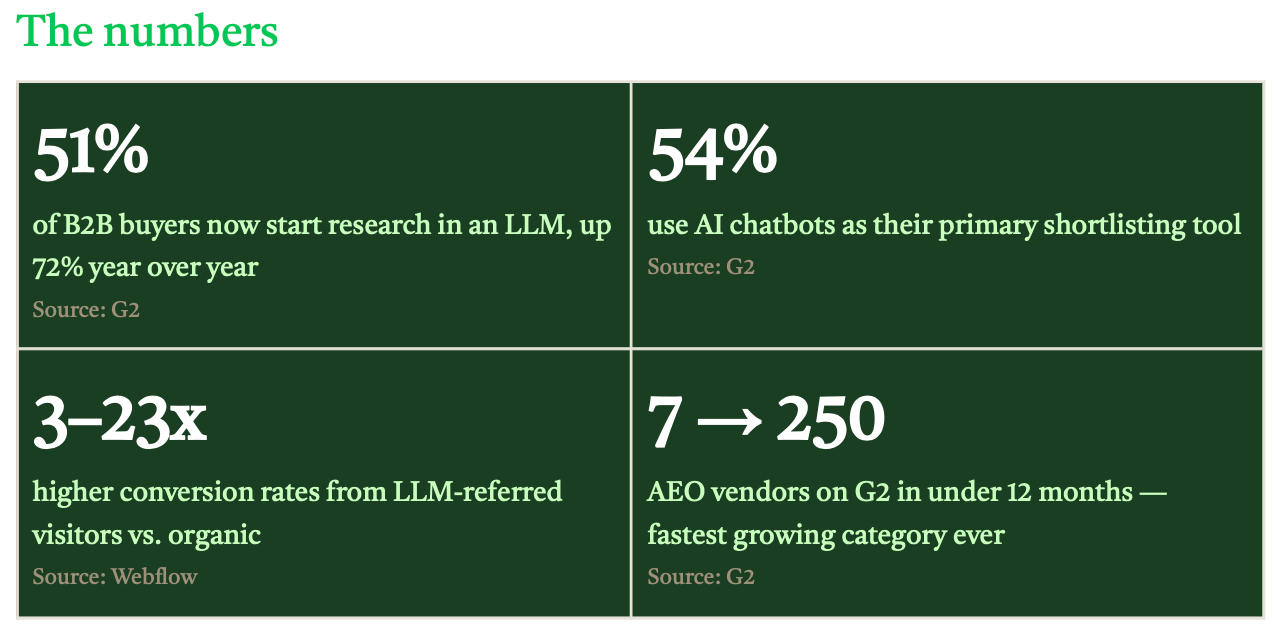
Three of the G2 numbers confirm what you already suspect. Buyers are starting their research in AI tools, they are using chatbots to build shortlists, and the number of AEO vendors has gone from a handful to a crowd in under a year.
The fourth number is the one I would build a budget conversation around. Webflow reports that visitors who arrive from an LLM convert at three to twenty-three times the rate of organic visitors.
That is Webflow’s reported figure, not something I have verified against my own data, and the wide range is worth taking with a grain of salt. AI referrals are still a small slice of most companies’ traffic, so a high multiple can sit on a small absolute number. Even so, the low end of that range is large enough to be worth understanding.
When someone asks ChatGPT for the best option in your category, and your name appears in the answer, the comparison work is already done by the time they reach your site. They are not arriving to discover you. They are arriving to confirm a choice the model has helped them narrow down.
That is a different visitor from the one who clicks on a Google result. The Google visitor is still deciding whether you are worth their time. The AI-referred visitor has been handed a shortlist and is checking whether you belong on it. Most of the doubt has already been resolved before they land.
This is also why I would not lead with citation counts. Most teams measure AI visibility by how often they show up in answers, because it is easy to pull and it feels like progress. But appearing in an answer and converting from it are different things. A brand can be mentioned constantly and still lose every buyer at the comparison stage, and a mention tracker would call that a good month.
The conversion gap is the number that tells you whether any of this is working. If the people arriving from AI answer close at several times the rate of everyone else, the work pays for itself even at low volume. That is the case I would take to a CFO, not a slide showing how many times the model said our name.
The Most Important Line in the Playbook
There is a single line in the playbook that is worth more than everything around it.
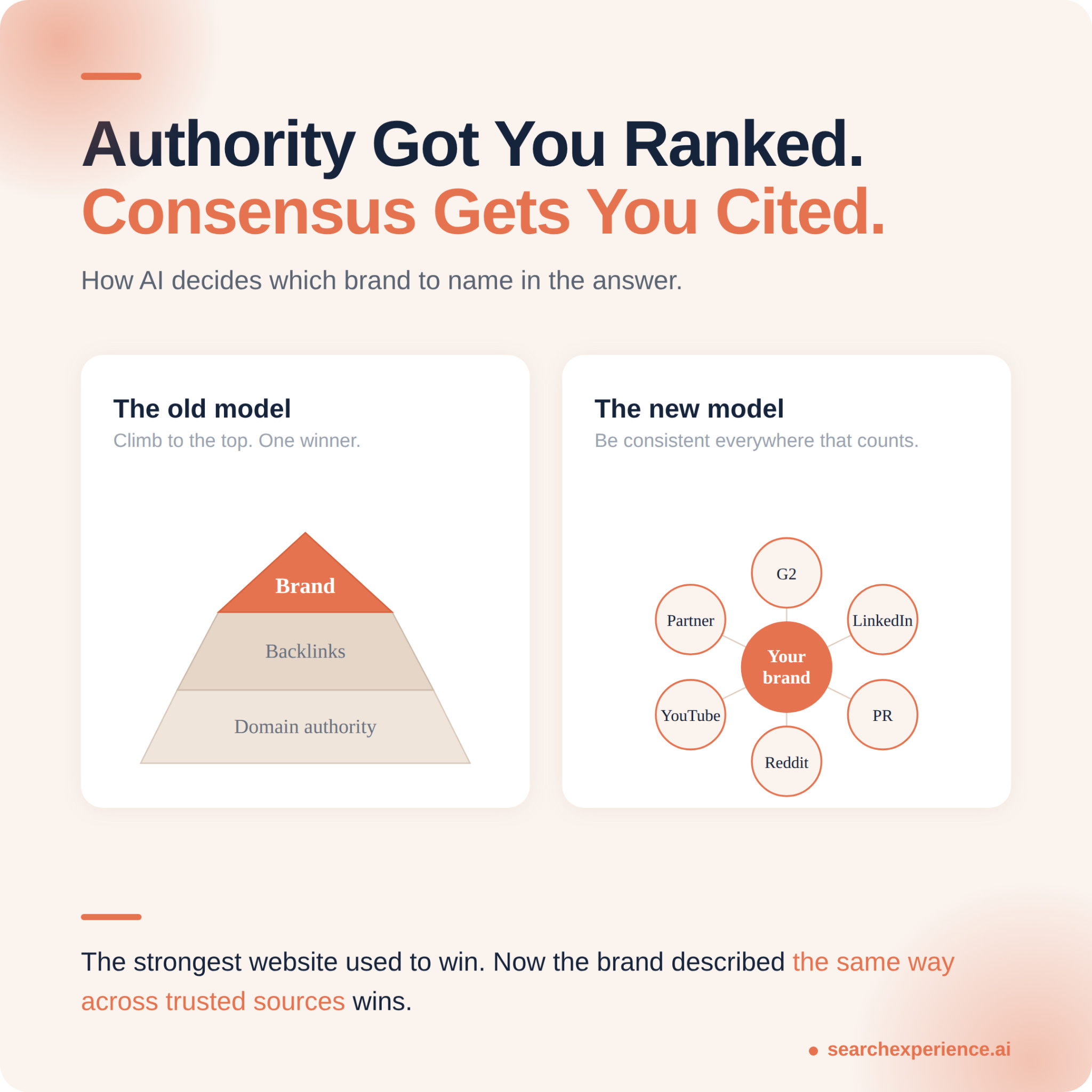
LLMs optimize for consensus, not authority.
For most of the last twenty years, the brand with the strongest domain and the best backlinks has won the ranking. You built authority, you defended it, and it mostly held its position once you earned it.
Models work off a different signal. When one builds an answer, it draws on what it has seen repeated across the sources it trusts.
The brand it names is often not the one with the most authority in the old sense. It is the one whose story appears the same way in enough trusted places that the model treats it as fact.
Authority still matters. A claim repeated across weak sources will lose to one carried by a few strong ones. What has changed is that authority sitting in one place, your own site, counts for less than the same authority showing up across the places a model already trusts. The single strong domain used to be the whole game. Now it is one input among several.
That is a real change in how visibility gets built, and it is the idea I want to come back to next week, because it deserves more than a section.
For now, it is enough to say that the old instinct, win the ranking and the rest follows, does not map cleanly onto how models choose what to cite.
What the Playbook Gets Right
A few of its recommendations are correct and badly underused. Three are worth pulling out.
G2 is an AI asset, not a wall of star ratings
The playbook is right that G2 reviews are quoted almost word-for-word in LLM answers, and that G2 is the most heavily cited source for B2B software comparisons.
Most companies treat G2 as social proof, something a buyer checks near the end to feel safe about a decision. That is no longer its main job. G2 is now shaping how AI systems describe you to a buyer who may never click through to read a single review.
Which means your profile is content. Write it in the words people actually use when they describe their problem to a chatbot, not the words your brand team prefers.
“Teams use us to kill the weekly status meeting and keep projects moving without an email thread” does more for you than “a leading project management solution.”
The playbook also notes that G2 reviews are syndicated to the AWS and Azure marketplaces, which would broaden the footprint without extra work on your end. Worth confirming that the arrangement is still current before you lean on it, since marketplace partnerships shift, but the principle is sound either way.
Open your knowledge base to the bots
Content behind a login generally cannot be read by these systems, which means it usually cannot be cited. If your best implementation guides and documentation sit behind a wall, you have hidden your most specific material from the systems shaping buyer decisions.
This one is a single change with a permanent payoff.
Add a “how did you hear about us” question today
First-touch and last-touch tracking are both blind to the AI part of a buyer’s path. Someone who researched you in ChatGPT, visited three times, and then booked a demo lands in your CRM as direct or organic, with the AI step nowhere in the record.
One question on your demo form starts giving you data that no analytics tool will. Add it before your AI traffic grows, so the baseline exists.
Where I Disagree With It
Two things in the playbook are bolder than the nuance underneath them.
Repetition is not the same as duplication
The playbook frames it as Google penalizing duplication while LLMs reward it. Google’s own position is that it filters and consolidates duplicates, selecting one version and suppressing the rest, rather than imposing a penalty. The practical effect is similar enough, and the broader point holds. A model reads the same narrative across many trusted sources and treats the repetition as a signal that it is true.
But Google has not gone anywhere. It still indexes your pages and still feeds AI Overviews. Copy-paste the same block across every property without thinking, and you can dull one surface while building another.
The version that works is consistent core messaging shaped to fit each platform, not the identical paragraph dropped into ten boxes.
Not every source carries the same weight
The playbook treats distribution as if every citation counts the same. They do not. A line in a respected trade publication carries more weight than a syndicated release. A named mention in an analyst report carries more weight than a forum comment.
Ten citations from strong sources will move you further than fifty from weak ones, and a strategy that chases raw volume will spend a lot of effort for thin returns.
The Thing Neither the Playbook Nor Most of This Conversation Says
Almost everything written about AEO right now is about distribution. Where to put your content, how many places to repeat it, and which sources the models trust.
But distribution only reinforces a narrative. It cannot create one.
If the thing being repeated across all those trusted sources is generic, the consensus you build is generic. Models will happily agree that you are one of several adequate options in your category, and that consensus does you no good. The brands that benefit from all this are the ones that have something specific worth repeating in the first place. Original research. A framework nobody else uses. A point of view on the category. They have the data.
That part is harder than optimizing a G2 profile, which is probably why the playbooks skip it. You can distribute your way into being mentioned. You cannot distribute your way into being the answer. The narrative has to be worth carrying before any of the distribution tactics matter.
What to Take From This
The playbook is a good starting point. Read it, hand it to your team, and use the 30/60/90 plan as a checklist.
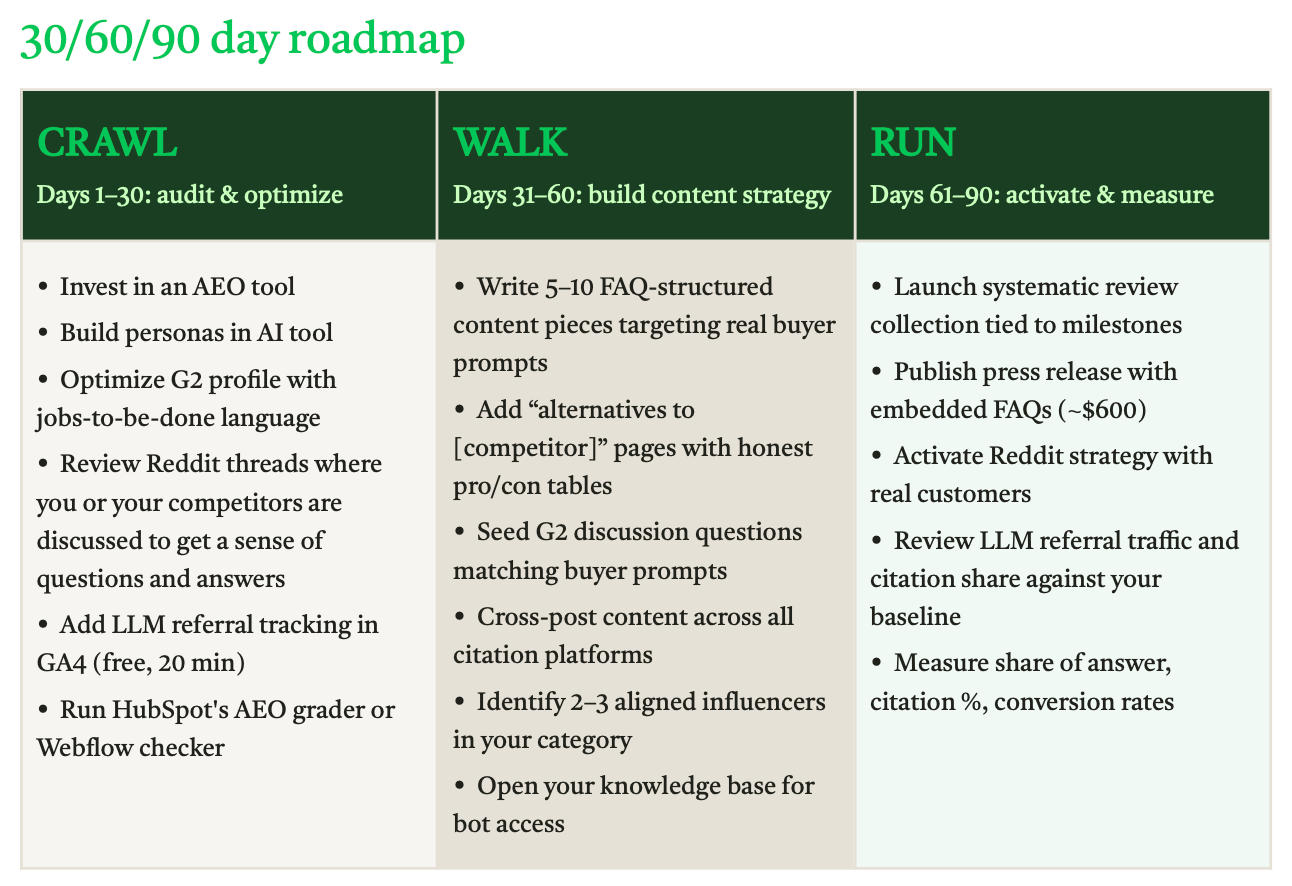
But the tactics are the easy part. The harder shift is in what you are aiming at.
For twenty years, the goal was to build the most authoritative website in your category. The work all pointed inward, at your own domain, your own pages, your own authority. That goal has quietly changed. The job now is to be described accurately across the handful of sources AI systems trust, and to be known for something specific enough to stand out.
That is a different kind of work, and most brands have not noticed it has changed.
Next week, I am going deeper into the consensus idea itself. The specific ways I watch brands get this wrong, even when they are doing everything else right.
Source: AEO Playbook for B2B Software Companies, Scale Venture Partners, April 2026. Based on a session with Sydney Sloan, CMO Advisor, G2. Conversion data originally from Webflow.
Pratik Dholakiya
AI Search Visibility Practitioner
Founder, Growfusely | SearchExperience.AI
The point about distribution reinforcing a narrative rather than creating one really stood out. In niche B2B markets, original research, practitioner insights, and a clear point of view are often what make content worth citing in the first place, whether by people or AI systems.