

I went into this audit expecting to find a problem. Instead, I found a brand doing almost everything right.
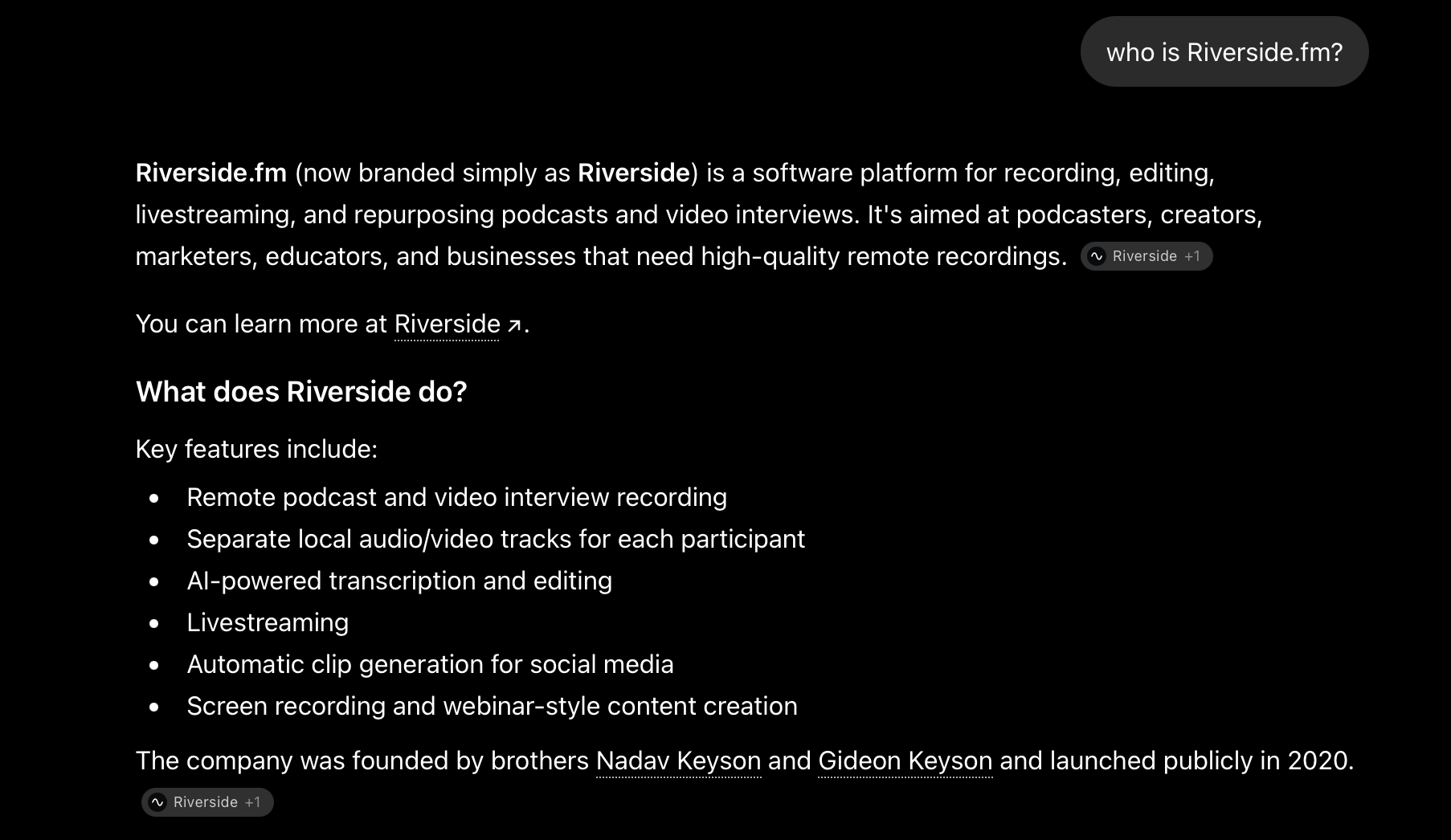
I ran Riverside through ChatGPT to see how the model describes it. Riverside makes software for recording and producing podcasts and videos. I expected the usual mess, where a brand is described one way on its own site and another way everywhere else, and the model ends up unsure what the company actually is.
Although that is not what came back.
Riverside is one of the cleanest examples of AI visibility I have looked at in a while. When I asked for the best podcast recording tools, it came back as ‘Best Overall’. Same when I asked about remote recording platforms. I asked the model to describe it in one sentence, three separate times, each in a fresh chat, and the answer barely moved. I asked how it compares to Descript and Zencastr, and the model gave concrete, specific differences rather than vague filler.
By every measure I usually check, Riverside is winning.
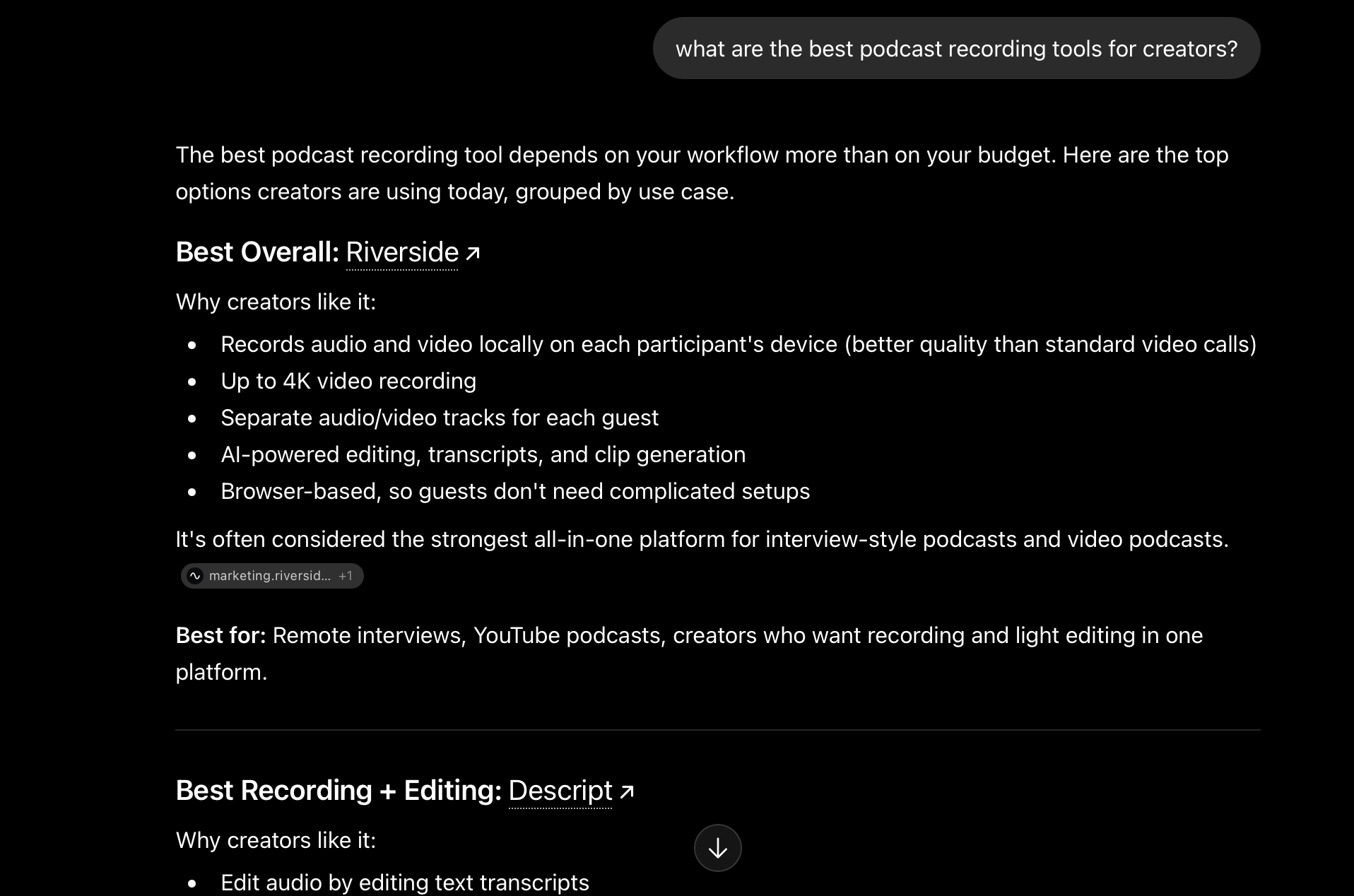
And it still had a gap. A small one, the kind only a brand this far along would have left. That gap is what this issue is about: most brands will run into it eventually, and very few will see it coming.
Last week I said I would go deeper into consensus and the ways brands get this wrong, even when they are doing everything else right. It turned out to be more interesting than I had anticipated, because Riverside is not getting it wrong in any of the usual ways. It is getting it wrong in a way you only reach by doing everything else right.
What the Model Knew, and What It Missed
The model kept describing Riverside through its origins.
Riverside started in 2020 as a tool for high-quality remote podcast recording. That is what it was known for, and that is the story that spread across reviews, Reddit threads, comparison articles, and roundups for years.
The model knows that story cold. Ask it about Riverside and you get remote recording, local files, studio-quality audio, the reliable option when someone’s internet is shaky. All of it: accurate and a little dated.
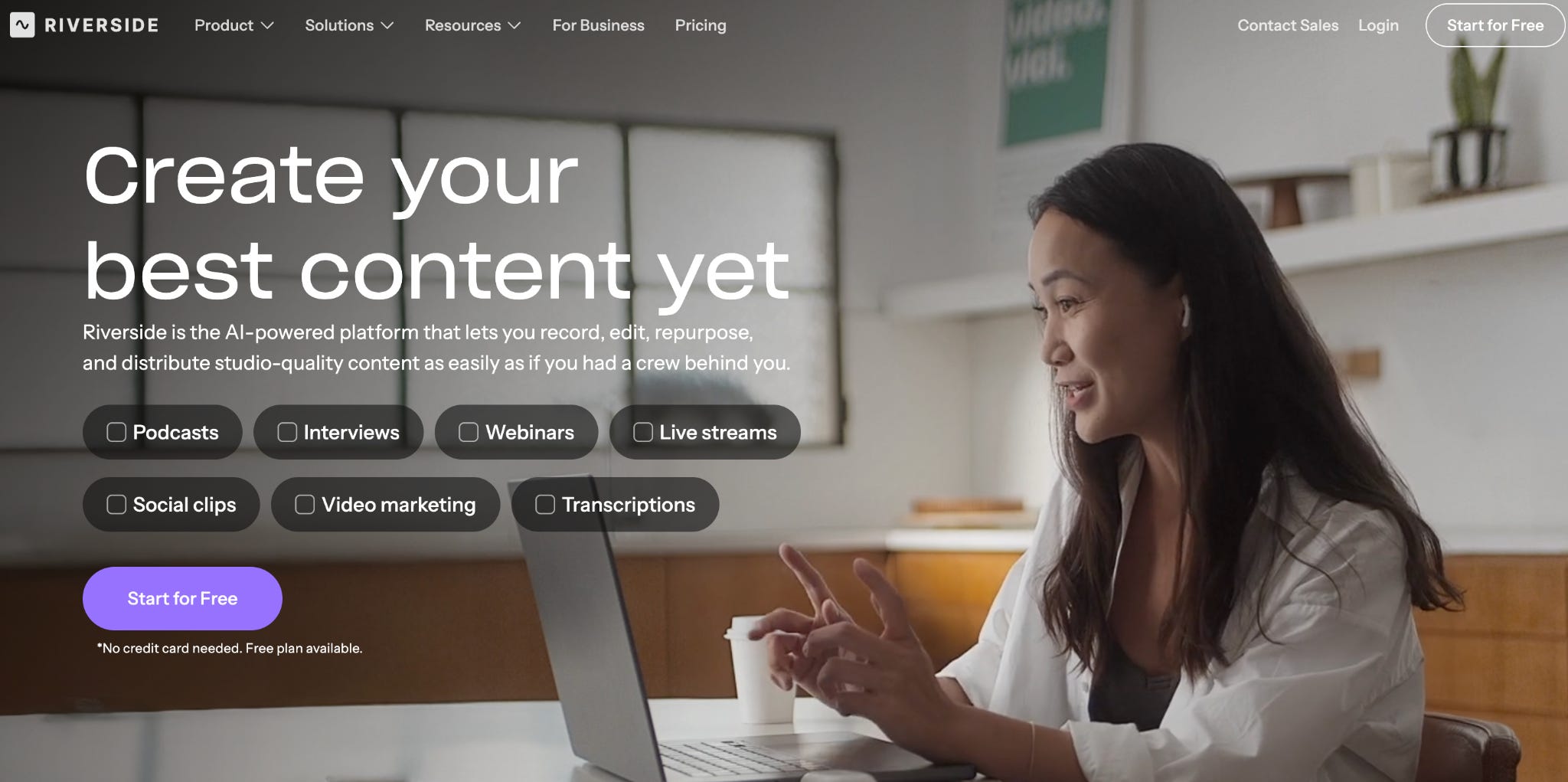
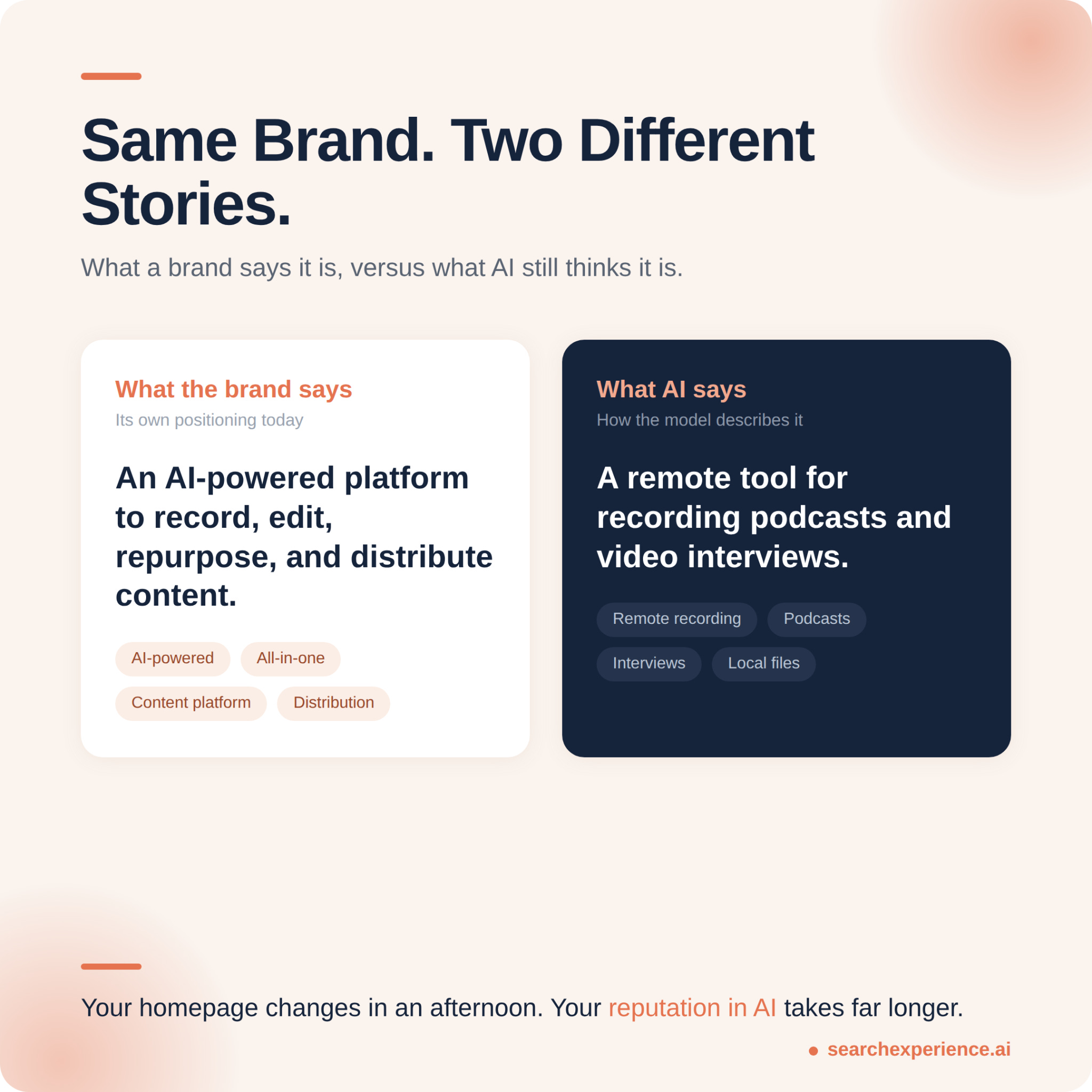
The dated part matters because Riverside has moved on. Its own homepage now calls it an AI-powered platform to record, edit, repurpose, and distribute content. It recently rebranded and moved its main site. The company wants to be seen as an end-to-end content platform now, well beyond a recording app.
The model has not caught up. It still leads with the old identity and treats the broader, newer positioning as a footnote. The brand moved. Its reputation within the model has not kept pace with it yet.
You Can Outrun Your Own Consensus
Here is the part worth sitting with.
AI does not describe you based on what you say about yourself today. It describes you based on what credible sources have said about you, built up over the years. The picture it gives leans toward whatever has been repeated the most across those sources.
So when you change your positioning, the model does not change with you. It keeps describing the version of you that has been discussed the longest. You can update your homepage in an afternoon. You cannot update years of accumulated mentions in an afternoon.
Riverside repositioned faster than its own consensus could keep up with. I would not call that a mistake on their part. It is just how AI search works, and it applies to every brand that grows or changes.
The brands most exposed to this are the ones changing the most. If you have rebranded, moved upmarket, added a product line, shifted from a single tool to a platform, or changed who you sell to, there is now a gap between who you are and who the model thinks you are. The more you have changed, the wider that gap tends to be.
Why This Goes Beyond the Usual Advice
Most advice about AI visibility comes down to consistency. Describe yourself consistently across all contexts so the model receives a clear, repeated signal. That advice is correct, and I have given it myself.
But consistency assumes your message has settled. It tells you to repeat the same thing across every source until the model hears it clearly.
Riverside is the harder case. What do you do when the thing you need to repeat is new, and the consistent story across all your older sources is the one you have outgrown? The repetition that built your old reputation is now slowing down the change you are trying to make. The history you created is the thing you have to work against.
What to Do When You Have Moved On
If there is a gap between your current positioning and how AI describes you, four things close it over time. I will keep these short, then show what they look like on a real brand.
Find the gap first
Run the audit. Ask ChatGPT and a couple of other tools who you are and what you do, then compare their answers with how you describe yourself now. If the model is describing an older version of you, that is your gap. You cannot fix something you have not measured.
Get the new story into trusted sources beyond your own site
Your homepage already has the new positioning. That is not where the model is looking hardest. The new story has to reach the third-party sources the model trusts, like review profiles, press coverage, and industry articles, the places where other people describe you. Updating your own site is necessary, but on its own, it will not move the answer.
Repeat the new positioning until it outweighs the old
Consensus gets built through repetition over time. The old story took years to set, so the new one will not replace it in a month. Say the new thing, in the same words, across enough trusted sources, for long enough that it starts to outweigh what came before.
Be patient longer than feels natural
This is the hard part. You changed months ago, so the change is old news to you. To the model, it has barely registered, because the sources it trusts are still catching up. The gap between your reality and the model’s picture of you is real, and closing it will take longer than you want.
If Riverside Were My Client
These four steps are the principles. Here is what they look like on a real brand. Riverside is not a client, so this is a thought exercise, but it is the one I would run if they were.
The audit gives me a clear place to start, because I can see where the model is stuck and why.
Rewrite the G2 profile first
G2 was one of the heaviest sources the model relied on, and Riverside’s G2 description still leads with “recording”. That makes it the highest-leverage fix on the list:
It is one page, and the company controls it directly.
It feeds a source the model already trusts and quotes.
It can be changed this week, not over months.
I would rewrite the opening lines to describe the all-in-one content platform, with recording as one capability rather than the headline.
Get into the sources that actually get cited
The press covered Riverside’s rebrand, which helps. But one wave of launch coverage will not outweigh years of older articles that still call it a recording tool.
The new positioning needs to reach the pages the model reads when it decides what a brand is:
Comparison articles
Category roundups
Review sites
Most of those still describe the old Riverside. That is the work, getting the current story into the places other people write about you.
Claim the category you are moving toward
Riverside wins “best podcast recording tool” with ease. It does not yet show up for “best AI content platform” or “best content repurposing tool,” which are the categories it wants now.
Right now, there is almost no content from Riverside or anyone else that connects the brand to those newer categories in a way the model can pick up. I would build that content and earn mentions inside it, so the model starts filing Riverside where the company is actually headed.
Re-audit every quarter and watch for movement
The last step is to keep measuring. I would rerun the same audit every quarter and monitor the one-sentence description for any movement.
When the model starts leading with the platform language rather than the recording language, the work lands. Until then, keep feeding the new story into the sources that count.
None of this is fast, and that is the honest part. But it is the difference between waiting for the model to notice on its own, which can take a year or more, and pulling the description toward where the brand already is.
The Takeaway
Riverside is handling this well, which is exactly why its only real gap now is timing. Most brands are not at that stage yet. But every brand that grows will eventually change what it is, and the moment it does, it inherits this same problem.
AI search has a memory. It remembers who you were, and it is slow to learn who you have become. Being described consistently is only half of it. The other half is making sure that what is being described is still true today.
When you reposition, you can tell the market in a quarter. The model takes longer. Plan for that lag, because it is coming for every brand that changes, and the ones who plan for it close the gap while everyone else wonders why the answer still sounds like last year.
Pratik Dholakiya
AI Search Visibility Practitioner
Founder, Growfusely | SearchExperience.AI